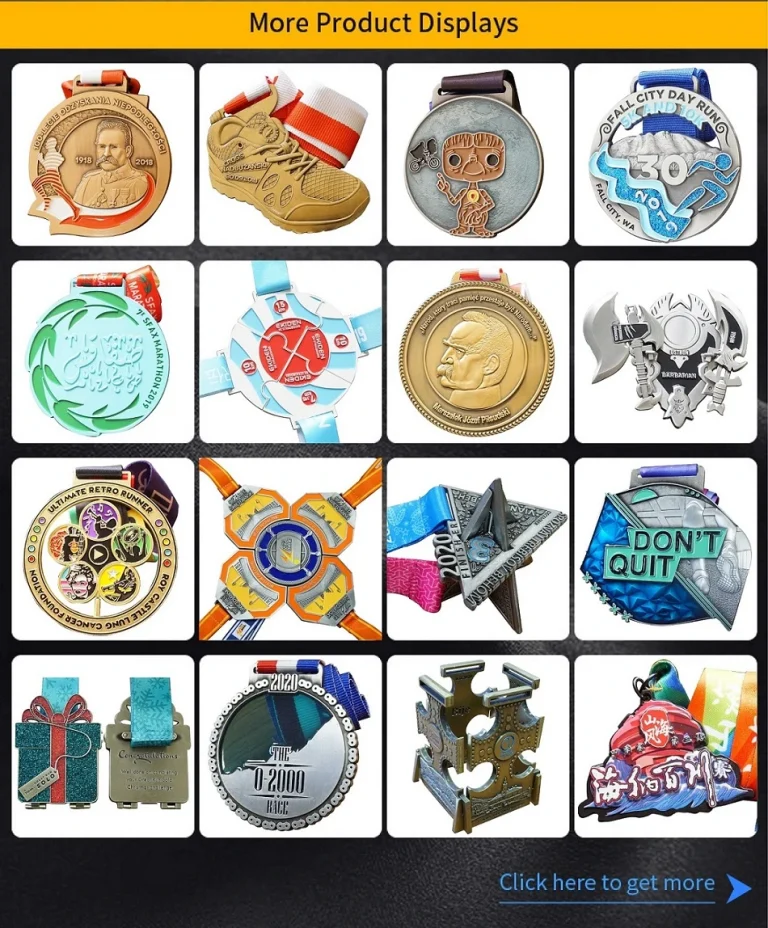
The main difference between 2D and 3D custom medals is the way depth is created. A 2D medal uses distinct raised and recessed levels with mostly flat surfaces. A 3D medal uses gradual curves, sculpted contours and multiple depths to reproduce faces, buildings, animals or other dimensional subjects.
Both methods can produce excellent results. The right choice depends on the artwork, finish, budget and how the medal will be viewed.

2D and 3D medals at a glance
| Feature | 2D medal | 3D medal |
|---|---|---|
| Surface | Flat raised and recessed levels | Rounded, sloped and sculpted relief |
| Best artwork | Logos, text, icons, geometric graphics | Portraits, architecture, animals, landscapes |
| Color filling | Easy to define with metal borders | Usually selective; color can hide sculpted detail |
| Tooling | Simpler mold preparation | Requires a sculpted depth model |
| Visual style | Clean, graphic and brand-focused | Dimensional, realistic and premium |
What is a 2D custom medal?
A 2D medal is built from clearly separated levels. Think of a logo raised above a recessed background, with the top of each area remaining flat. Metal lines can divide enamel colors, outline letters and keep small elements visually organized.
2D production is well suited to event marks, school crests, club emblems and sponsor logos. It also works effectively with soft enamel because recessed areas can hold color while raised metal lines stay visible.
Advantages of 2D medals
- Clear reproduction of logos and typography.
- Efficient use of spot colors and Pantone matching.
- Usually easier to review from a conventional vector proof.
- Good readability on medium and small medals.
- Compatible with polished, antique and dual-plated finishes.
Limitations of 2D medals
Flat levels cannot fully reproduce rounded cheeks, flowing fabric, muscle definition or the natural contours of a landmark. Adding more flat layers may suggest depth, but it does not create the same realistic result as sculpted relief.
What is a 3D custom medal?
A 3D medal translates artwork into a relief model with gradual changes in height. The highest areas catch light, while valleys and slopes create shadows. This makes 3D effective for portraits, statues, mascots, mountain scenes and historic buildings.
The effect is often strongest with an antique finish because darker recessed areas emphasize depth. Selective polishing can highlight a face, logo or border without covering the sculpted detail.
Advantages of 3D medals
- More realistic portraits and organic subjects.
- Greater depth and premium tactile quality.
- Strong performance with antique metal finishes.
- Useful when the design depends on light and shadow rather than color.
Limitations of 3D medals
A 3D model requires more preparation and careful proofing. Very small text still needs to remain relatively flat for readability. Heavy enamel coverage may also reduce the visible relief, so 3D artwork often uses color selectively.
Can one medal combine 2D and 3D?
Yes. A hybrid design is often the most practical solution. A marathon medal can use a 3D landmark in the center while keeping the event name, date and sponsor marks in crisp 2D levels. This separates the emotional focal point from the information that must remain legible.
A hybrid approach can also limit sculpting to one side. The reverse may remain 2D for results, distance, a short message or engraved personalization.
Artwork requirements
For 2D medals
Vector artwork is preferred because clean paths define the raised metal, recessed areas and enamel colors. Text should be converted to outlines, and closely spaced lines may need simplification for casting.
For 3D medals
Provide several references when possible: front, side and three-quarter views. High-resolution photographs help a sculptor understand volume. A single flat logo can be interpreted in 3D, but the designer needs guidance about which areas should be highest and lowest.
How the choice affects price
Price depends on more than the 2D or 3D label. Diameter, thickness, quantity, metal, finish, enamel, attachments and packaging all matter. A simple 3D center on an otherwise standard medal may be economical, while a large, double-sided, high-relief piece requires more tooling and production time.
Ask suppliers to quote the same dimensions and specifications. Otherwise, a low 2D price and a premium 3D price are not a meaningful comparison.
Which option should you choose?
- Choose 2D when accurate logos, text and bold color are the priority.
- Choose 3D when the emotional value comes from a portrait, sculpture or realistic scene.
- Choose hybrid when you need a realistic focal point plus crisp event information.
This 3D running medal example shows how raised scenery and an antique finish work together.
Frequently asked questions
Is 3D always better than 2D?
No. A clean 2D design is often better for flat logos, small lettering and strong enamel color. 3D is valuable only when the subject benefits from sculpted depth.
Can 3D medals include enamel?
Yes, but color should be placed where it does not obscure important relief. Many designs combine 3D metal with limited enamel accents.
Can both sides be 3D?
They can, provided the medal thickness, edge and highest relief points are engineered correctly. Double-sided 3D tooling normally adds cost and proofing time.
Before approving the proof
Request a depth view, not only a front-facing rendering. Confirm the highest and lowest areas, finish, text height, enamel placement and medal thickness. The MedalsChina design team can evaluate whether 2D, 3D or a hybrid structure will reproduce your artwork most clearly.