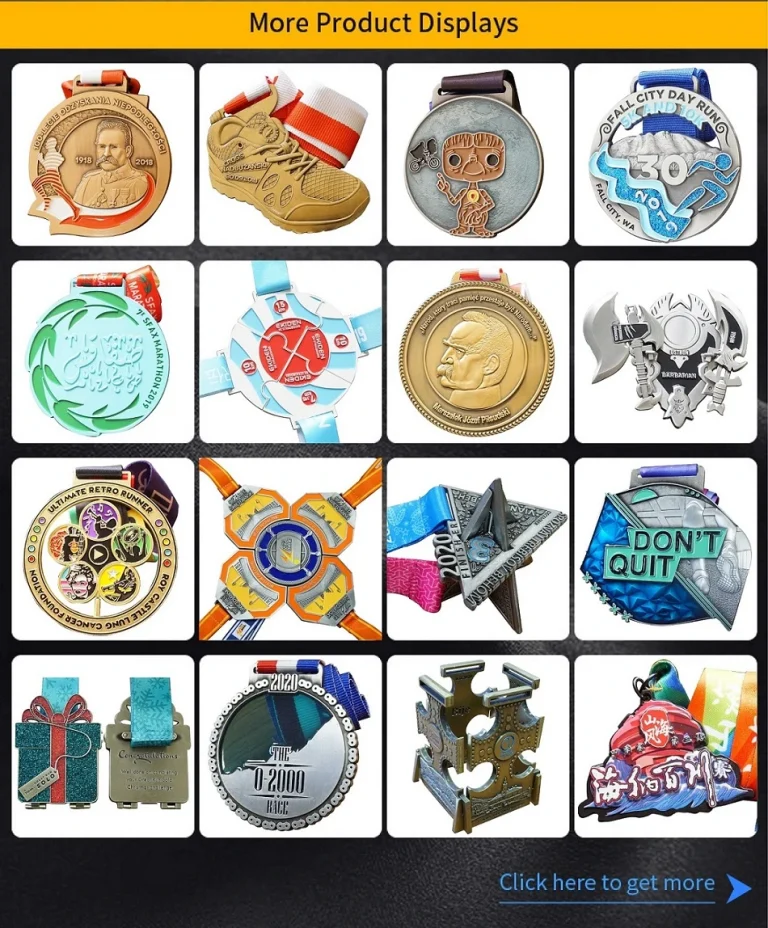
A spinner medal combines a fixed outer frame with a rotating center, ring or panel. It is most effective when the movement supports the event story—such as a wheel for cycling, a compass for adventure, a ball for sport or a changing message for a race series. The mechanism needs structural clearance, balanced artwork and reliable assembly, so it should be planned before the final illustration.
Spinner medal structures compared
| Structure | Movement | Best for | Main check |
|---|---|---|---|
| Center axle | Inner disc rotates around a pin | Simple interactive race medals | Axle security and side clearance |
| Bearing spinner | Bearing supports smoother rotation | Premium keepsakes and frequent handling | Bearing fit and long-term movement |
| Rotating ring | One or more rings turn around the center | Maps, clocks and multi-stage themes | Alignment of every layer |
| Flip or swing panel | Panel moves between two faces | Before/after or dual-message designs | Stop position and edge contact |
How a spinner medal is made
The fixed frame and moving component are normally produced as separate parts. Each part is cast, trimmed, polished, plated and colored before assembly. A pin, axle or small bearing joins the pieces. Cold assembly helps protect finished enamel and plating from heat damage.
Because each component passes through production independently, colors, plating and thickness must be specified for both. A two-part medal can also use contrasting finishes, but the proof should label each surface clearly.
Start with a reason for movement
A rotating piece should reveal information, create a game, reinforce a sport or represent progress. Movement added only as decoration can make the medal heavy and expensive without improving the recipient experience.
Write one sentence describing the interaction: “The bicycle wheel rotates,” “the compass points move,” or “the center aligns the three race stages.” This instruction helps the engineer identify the correct axis and component boundaries.
Design the fixed frame first
The outer frame carries the ribbon connection and protects the moving part. It needs enough metal around the cavity to remain rigid. Avoid thin bridges near the loop, especially on large cut-out designs. The frame must also leave finger access if recipients are expected to spin the center.
Use the medal diameter and thickness guide to control overall weight. A large spinner may be more comfortable when open areas remove unnecessary metal.
Artwork rules for the rotating center
Keep important text away from the axle and mechanical clearance zone. Centered logos, wheels, globes and symmetrical emblems rotate naturally. Directional artwork can appear upside down, which may be intentional but should be shown in the proof.
If the rotating piece must stop at specific positions, tell the factory. Free rotation, indexed clicks and a limited swing require different construction. Do not expect a standard free spinner to hold one precise orientation.
Axle versus bearing
A simple axle can be economical and reliable for moderate rotation. A small bearing can create smoother movement and better alignment, but it adds component cost and demands more accurate tolerances. The best option depends on diameter, weight and how often the medal will be handled.
Ask for a working sample when smooth rotation is central to the product promise. A visual proof cannot demonstrate friction, wobble or sound.
Materials, thickness and plating
Zinc alloy is commonly used because it can form separate dimensional components and structural recesses. The parts may use matching gold, silver or antique plating, or contrasting finishes for the moving feature.
Do not make every piece as thick as a standard solid medal. The combined stack controls total thickness. Review the finish options in the custom medal finish guide.
How a spinner affects price and timing
Spinner medals require multiple molds or components, separate finishing and manual assembly. Bearings, dual plating, complex enamel and special packaging add further cost. Production also needs time for movement tests and corrective assembly.
Request an itemized quotation that separates the medal body, moving part, ribbon, packaging, sample and freight. For deadline planning, use the custom medal production timeline and allow additional proofing for mechanics.
Quality-control tests
- Rotate every sample through a full cycle.
- Check for scraping between plated surfaces.
- Confirm the axle or bearing cannot be pulled out by normal handling.
- Inspect wobble from the front and side.
- Verify enamel is not chipped near assembly points.
- Confirm the medal hangs upright from its ribbon.
- Test packaging so pressure does not bend or jam the spinner.
- Compare noise and resistance across multiple units.
Packaging and recipient use
A spinner should not be packed so tightly that the moving part bears the load. Use a pouch, tray or box that supports the outer frame. Add a small instruction card if the motion is not obvious or if several pieces align into a specific result.
For presentation options, compare the custom medal packaging guide.
Frequently asked questions
Do spinner medals rotate 360 degrees?
Many do, but flip panels and indexed mechanisms may have limited movement. Define the desired motion in the specification.
Are spinner medals suitable for children?
They can be, but the axle, small components, edges and intended age group require a safety review.
Can both sides of the spinner have artwork?
Usually yes, provided the structure exposes both sides and the axle area remains clear.
Do spinner medals take longer to make?
Normally yes because separate components must be finished, assembled and tested.
Request a mechanical proof and sample
Provide front, back and side concepts plus a written description of the movement. Send the event date early enough for testing. Start with the MedalsChina inquiry form and identify the moving component, desired rotation, size, quantity and delivery date.